

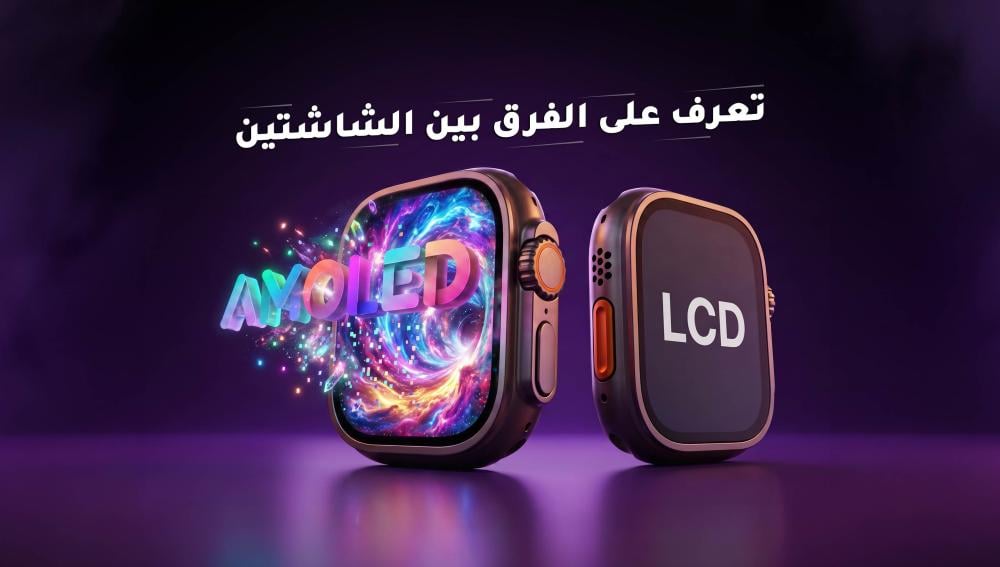
Discover the Difference Between AMOLED and LCD Displays ⌚✨
And Why Your Smartwatch Display Makes a Real Difference
When choosing a smartwatch, the first thing that probably catches your eye is the design. Then you start checking out the features: calls, notifications, sports modes, battery life, and more.
But there’s one part you’ll see and interact with every single time you raise your wrist, yet many people don’t give it enough attention:
The display. 👀
Not all smartwatch displays are the same. Two of the most common technologies you’ll come across are LCD and AMOLED.
So, what’s the difference between them? And why has AMOLED become such a sought-after feature in smartwatches?
Let’s keep it simple 👇
First Things First: What’s the Difference Between LCD and AMOLED? 🤔
The main difference comes down to how the screen produces light.
An LCD uses a backlight, meaning there’s a light source behind the pixels that helps create the image you see.
With an AMOLED display, each pixel can produce its own light independently.
You might be thinking:
“Okay, cool… but what does that actually mean for me?” 😅
That’s where the differences you can actually see and feel in everyday use begin.
⚫ With AMOLED, Black Is Actually Black
When part of an AMOLED display needs to show black, those individual pixels can switch off completely.
The result?
Deeper blacks and impressive contrast.
And this works especially well on smartwatches, where many watch faces use black or dark backgrounds.
Imagine a sleek black watch face with the time, icons, and information standing out in bright, vibrant colors…
The result? A clean, premium look right on your wrist. ✨⌚
At that point, the display isn’t just there to show you the time. It becomes part of the watch’s overall design and style.
🌈 Colors That Make Your Watch Faces Look Even Better
One of the best things about owning a smartwatch is being able to change the watch face to match your mood, outfit, or style.
Going sporty today? 🏃
Classic tomorrow? ⌚
Something colorful and fun for the weekend? 😎
This is where AMOLED really shines.
AMOLED displays typically offer vibrant colors and high contrast, helping icons, graphics, and watch faces look more vivid and eye-catching.
And when your watch is something you wear throughout the day, a beautiful display isn’t just a small detail.
☀️ What About Visibility During Everyday Use?
You don’t only use your smartwatch while sitting indoors.
You might check it while walking, working out, driving, or spending time outdoors.
That’s why display visibility matters.
Modern AMOLED displays can offer impressive brightness levels, but there’s one important thing to keep in mind:
Not every AMOLED display is automatically brighter than every LCD display.
Brightness depends on the specifications and quality of the display itself.
So no, the word “AMOLED” isn’t magic 😄 — but it’s a display technology capable of delivering an excellent viewing experience when paired with a high-quality panel.
🔋 Does AMOLED Make a Difference to Battery Life?
Yes, and this gets particularly interesting when we’re talking about smartwatches.
Remember how we said black pixels on an AMOLED display can switch off completely?
Because of that, watch faces with large dark or black areas can require less display power than showing bright content across the entire screen.
So using a dark watch face on an AMOLED display isn’t only about thinking:
“Wow, that looks good!” 😍
It may also help reduce the display’s power consumption.
Of course, the smartwatch’s overall battery life depends on many other factors, including brightness, screen-on time, connectivity, sensors, and how you use the watch.
So… What Does All of This Have to Do With Our Smartwatches? 👀⌚
Well, this is exactly why we wanted to talk about displays in the first place.
When choosing the specifications for our smartwatch, the display could have simply been a place to show the time and notifications…
But we see it differently.
Think about how many times you interact with your watch throughout the day.
You raise your wrist to check the time.
A notification comes in.
You open a feature.
You check your activity.
You switch to a different watch face.
That’s why we chose an AMOLED display for our smartwatch. ✨
Not just so we could add another impressive-sounding term to the product page, but because display quality is something you can actually appreciate almost every time you use your watch.
Vibrant colors 🌈
Deep blacks ⚫
High contrast ✨
And watch faces that look even better on your wrist ⌚
It’s these little details that can turn a smartwatch from simply being another piece of technology…
into something you genuinely enjoy wearing and using every day.